Contract intake automation sounds like a software problem until legal ops tries to launch it.
Then the real blockers show up: requests arrive through five channels, business users skip required context, nobody agrees on the request taxonomy, high-risk deals need finance or security review, AI suggestions need human oversight, and the CLM handoff depends on fields that are not captured up front.
This checklist helps legal operations teams decide whether contract intake is ready for automation before they buy another tool, add AI triage, or ask the business to trust a new legal front door.
Short answer
Contract intake automation is ready when legal ops can show a stable request taxonomy, clear intake channels, required fields by contract type, routing and approval rules, documented exception paths, named human reviewers, CLM or CRM handoff requirements, audit evidence, and baseline metrics for request volume, completeness, cycle time, routing accuracy, and SLA performance. If those pieces are missing, automation will mostly create a faster version of the same scattered inbox.
Red Brick Labs' view: readiness comes before tool selection. Use this checklist before the Best Contract Intake Automation Tools for Legal Operations Teams comparison, then convert the gaps into the Contract Intake Automation Requirements Template. If edge cases are already painful, pair it with How to Document Contract Intake Edge Cases Before Adding AI Automation, How to Build a Contract Intake Escalation Path for Human Review, How to Write Acceptance Tests for Contract Intake Automation Before Launch, and How to Monitor Contract Intake Automation After Go-Live.
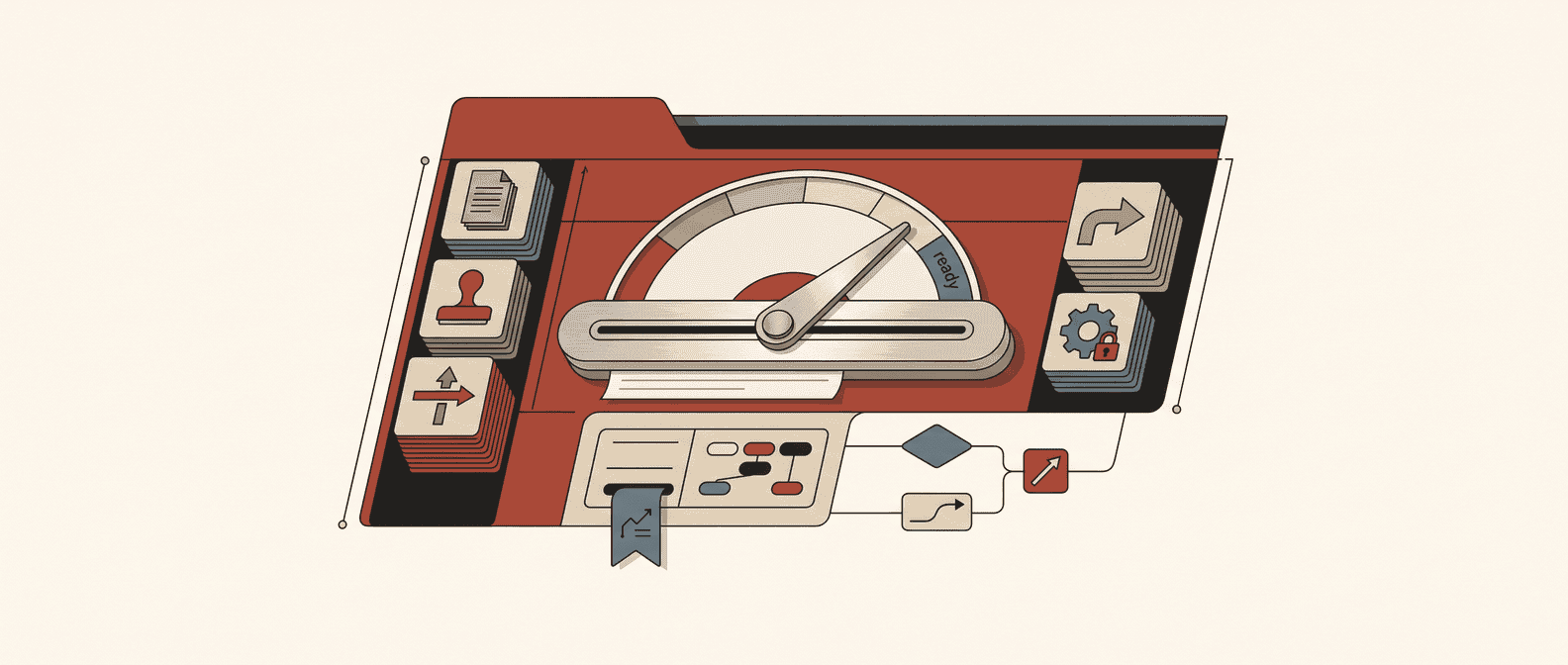
The contract intake automation readiness checklist
Use this as a working session with legal ops, one lawyer who handles requests today, a high-volume requester from sales or procurement, the CLM or systems owner, and any finance, security, privacy, or procurement owner who approves contract risk.
Score each area from 1 to 5.
| Readiness area | Score 1 | Score 3 | Score 5 |
|---|---|---|---|
| Business pain | "Legal intake is annoying" | Delays and rework are visible | Pain is tied to cycle time, revenue, risk, capacity, or requester experience |
| Request taxonomy | Everyone describes work differently | Common request types exist | Request categories and subcategories are documented and used consistently |
| Intake channels | Requests arrive anywhere | Some preferred channels exist | Approved channels are clear, measurable, and easy for requesters to use |
| Required fields | Legal asks follow-up questions every time | Core fields exist but vary by lane | Required fields are defined by contract type and risk level |
| Document rules | Attachments are inconsistent | Common document needs are known | Required document packages are defined by lane |
| Routing logic | A person manually decides every route | Some rules exist in people's heads | Routing by request type, risk, owner, value, and urgency is documented |
| Approval matrix | Approvals happen ad hoc | Key approvers are known | Legal, finance, security, privacy, procurement, and executive thresholds are clear |
| Exception handling | Exceptions live in Slack or email | Common exceptions are known | Edge cases, escalation paths, fallback owners, and SLA timers are documented |
| AI boundaries | "AI will triage it" | AI use cases are discussed | AI suggestions, confidence thresholds, citations, review rules, and forbidden actions are defined |
| CLM/CRM handoff | Manual copy/paste | Export or basic integration path exists | Field mapping, write permissions, status sync, rollback, and source of truth are defined |
| Audit evidence | Hard to reconstruct decisions | Some timestamps and comments exist | Requester data, files, approvals, AI suggestions, overrides, and status changes are logged |
| Metrics and ownership | No baseline | Estimates exist | Volume, completeness, cycle time, routing accuracy, SLA, exception rate, and owner cadence are measured |
Maximum score: 60. Multiply by 1.67 for a 100-point readiness score.
Readiness score
| Score | Readiness level | What it means | Recommended move |
|---|---|---|---|
| 85-100 | Pilot-ready | Intake has clear lanes, rules, owners, controls, and metrics. | Start a scoped pilot and write acceptance tests. |
| 70-84 | Ready with cleanup | The workflow is real, but a few gaps could break launch. | Fix the gaps, then write requirements. |
| 50-69 | Promising but premature | Automation would help, but process ambiguity is still high. | Run a two-week readiness sprint before tool selection. |
| 30-49 | Not ready | Automation would turn messy legal intake into a tracked mess. | Map the workflow, define lanes, and document edge cases first. |
| Below 30 | Wrong first automation | The team has not stabilized the operating model. | Pick a narrower lane or solve the intake basics. |
A low score is useful. It means legal ops found the implementation risk while it is still cheap to fix.
1. Business pain and pilot value
Do not start with "we need contract intake automation." Start with what the current intake mess costs the business.
Good readiness evidence:
- Average time from request submission to first legal touch.
- Average time from request submission to approval, redline, signature, or rejection.
- Number of legal follow-ups caused by missing context.
- Request volume by business team and contract type.
- Deals, vendor onboarding, renewals, or procurement requests delayed by intake gaps.
- Legal capacity consumed by triage instead of review.
- Risk created by requests that bypass legal, finance, privacy, security, or procurement.
If the pain is not tied to a measurable outcome, the pilot will struggle to prove value. Red Brick Labs usually looks for one narrow first lane where the business can see the difference: standard NDAs, low-risk order forms, vendor paper below a spend threshold, procurement requests, sales contract requests from CRM, or recurring amendments.
2. Request taxonomy
Legal intake automation needs a shared vocabulary.
At minimum, define:
- request category;
- contract type;
- business team;
- counterparty type;
- template vs third-party paper;
- new agreement vs amendment vs renewal;
- risk tier;
- urgency;
- required reviewers;
- downstream system of record.
Legaltech Hub's definition of legal intake and triage is useful here: intake gathers the initial information and triage prioritizes or assesses the request. In practice, automation needs both. If the taxonomy is fuzzy, the intake system cannot route, report, or improve.
Readiness test:
| Question | Ready answer |
|---|---|
| Can requesters choose from a short list of request types? | Yes, and legal has approved the definitions |
| Can two legal team members classify the same request the same way? | Usually yes |
| Can reporting group requests without manual cleanup? | Yes |
| Can AI be evaluated against known categories? | Yes, with expected labels and test examples |
If every request is "contract review," the workflow is not ready.
3. Intake channels
Readiness does not require one channel for every team. It does require a controlled channel strategy.
List every place contract requests arrive today:
- email;
- Slack or Teams;
- CRM;
- CLM launch form;
- procurement portal;
- ticketing system;
- spreadsheet;
- shared drive;
- direct lawyer messages;
- forwarded customer or vendor paper.
Then decide what the future state should be. Some teams need a CLM launch form. Some need CRM-triggered intake. Some need Slack or Teams as a front door. Some need an email-to-intake fallback. The point is not purity. The point is that every channel creates the same kind of structured request record.
Ironclad's legal intake workflow recipe is a good category signal: modern intake workflows are expected to centralize, capture, route, and manage incoming legal requests. Sirion's intake guidance makes the same operational point from the contracting side: dashboards, audit logs, SLA tracking, and analytics depend on the workflow collecting usable data.
Readiness test:
| Channel question | Ready answer |
|---|---|
| Do we know which channels will be allowed at launch? | Yes |
| Can we detect bypassed requests? | Yes |
| Can each channel create the same core request fields? | Yes |
| Can requesters see status without asking legal manually? | Yes, or there is a plan |
4. Required fields by contract type
This is where legal intake either becomes leverage or turns into a prettier questionnaire.
Required fields should vary by request lane. A standard mutual NDA should not ask the same questions as a vendor agreement with data processing, payment terms, and security review.
Common required fields:
| Field | Why it matters |
|---|---|
| Requester and business owner | Someone must own context and decisions |
| Contract type | Drives form logic, routing, templates, and reporting |
| Counterparty | Needed for conflicts, duplicate checks, records, and negotiation |
| Legal entity | Required for templates, approvals, and signature authority |
| Deal or spend value | Triggers finance, executive, procurement, or risk review |
| Deadline and reason | Separates real urgency from noise |
| Template or third-party paper | Changes review path and risk |
| Supporting documents | Prevents legal from hunting for SOWs, order forms, DPAs, or redlines |
| Privacy/security impact | Routes data, security, and compliance review |
| Non-standard terms | Flags liability, indemnity, payment, renewal, exclusivity, or termination risk |
Ironclad's launch form documentation and API documentation are a useful reminder: launch form fields, required fields, and conditionally required fields are not cosmetic. They become the contract workflow's input contract. If those fields are wrong, the workflow downstream will be wrong too.
5. Routing and approval logic
Before automation, legal ops should be able to write routing rules in plain English.
Examples:
- Standard NDA on company paper routes to self-serve or light legal review.
- Third-party NDA routes to legal review.
- Vendor agreement with personal data routes to legal plus privacy/security.
- Contract value above threshold routes to finance and executive approval.
- Non-standard payment terms route to finance.
- Customer paper with unusual liability routes to senior legal review.
- Missing business owner routes back to requester before legal review starts.
- Low-confidence AI classification routes to legal ops triage, not directly to a lawyer.
If routing depends on "ask Alex," automation is not ready.
Create a routing matrix:
| Condition | Route | Human owner | SLA | Evidence required |
|---|---|---|---|---|
| Standard NDA, company template, no edits | Self-serve or light review | Legal ops | 1 business day | Request fields, template version |
| Third-party paper | Legal review | Commercial counsel | 2 business days | Uploaded document, counterparty, business owner |
| DPA or personal data | Privacy/security review | Privacy + security owner | Immediate triage | Data categories, vendor, system, contract |
| High value or unusual payment terms | Finance review | Finance owner | 1 business day | Value, payment terms, business sponsor |
| Low-confidence AI classification | Triage hold | Legal ops | Same day | AI suggestion, confidence, source evidence |
6. Exception and escalation path
The happy path is not the real system. The exception path is.
Document what happens when:
- fields are missing;
- the wrong contract type is selected;
- the same request is submitted twice;
- the request is urgent without a reason;
- the business uploads the wrong document;
- the counterparty sends third-party paper;
- the request touches privacy, security, finance, procurement, or compliance;
- AI cannot classify the request confidently;
- an approver is out of office;
- the request sits too long without action.
Every exception needs a next action, owner, timer, and audit record. This is why the companion contract intake escalation path matters before launch.
7. AI readiness and human review
AI can improve contract intake. It can also make a bad intake workflow fail faster.
Use AI where it has a defined job:
- suggest request type;
- extract counterparty, dates, value, document type, and key metadata;
- summarize the uploaded contract packet;
- detect missing fields;
- flag likely privacy, security, finance, or procurement review;
- draft follow-up questions for requesters;
- suggest a route with evidence.
Do not use AI as a silent legal-risk decision maker. NIST's AI Risk Management Framework is not written for contract intake specifically, but the governance lesson applies: AI risk should be mapped, measured, managed, and governed, with documentation that supports transparency, human review, and accountability.
AI readiness checklist:
| Requirement | Ready when |
|---|---|
| Allowed AI tasks | Legal ops can name what AI may classify, extract, summarize, or suggest |
| Prohibited AI tasks | The workflow forbids silent approval, legal-risk decisions, or irreversible writes |
| Confidence thresholds | Low-confidence cases route to human review |
| Source evidence | AI suggestions link back to source text, request fields, or documents where possible |
| Correction loop | Human edits are logged and used to improve prompts, rules, or training data |
| Audit log | AI suggestions, human decisions, overrides, and downstream writes are recorded |
Red Brick Labs' rule: if AI touches routing, risk, or downstream records, the human review model is not optional.
8. CLM, CRM, and system handoff
Contract intake is rarely isolated. It often touches:
- CLM;
- CRM;
- procurement system;
- e-signature;
- document repository;
- ticketing system;
- Slack or Teams;
- finance or ERP systems;
- data warehouse or reporting.
Before automation, define:
- system of record for the request;
- system of record for the contract;
- field mapping from intake to CLM or CRM;
- who can create or update records;
- what happens when fields conflict;
- rollback path for bad writes;
- status sync rules;
- notification rules;
- audit and retention requirements.
Axiom's CLM overview frames contract lifecycle management from the moment a request comes in through drafting, review, approval, signature, storage, renewal, termination, or extension. That matters because intake data becomes lifecycle data. Bad intake metadata does not stay at the front door. It pollutes reporting, repository search, obligations, renewals, and downstream operations.
9. Audit evidence and observability
Legal ops should be able to reconstruct what happened without interviewing five people.
Capture:
- submitted request data;
- uploaded files and versions;
- source channel;
- requester and business owner;
- AI suggestions and confidence, if used;
- human reviewer decisions;
- approvals and rejections;
- comments and reason codes;
- routing changes;
- SLA timestamps;
- downstream system writes;
- overrides and exceptions.
OpenTelemetry's observability primer defines observability around understanding system behavior from its outputs. Legal intake is not distributed tracing, but the principle holds: production workflows need enough signals to debug what happened. If legal ops cannot see stuck requests, bad routes, missing data, and failed writebacks, the workflow is not production-ready.
10. Baseline metrics
Do not launch without a baseline. Otherwise, the project will be judged by anecdotes.
Track before and after:
| Metric | Why it matters |
|---|---|
| Request volume by lane | Shows where automation should focus |
| Complete request rate | Measures whether intake captures context up front |
| Time to first legal touch | Shows whether triage improved |
| Contract cycle time by lane | Connects intake to business speed |
| Follow-up count per request | Measures missing information and form quality |
| Routing accuracy | Proves taxonomy and rules work |
| SLA breach rate | Shows whether ownership and escalation are real |
| Exception rate | Reveals workflow maturity |
| AI correction rate | Measures whether AI suggestions are usable |
| Requester adoption | Shows whether the business uses the front door |
These do not need to be perfect. They need to be good enough to compare the old operating model to the new one.
The 10-day readiness sprint
If the score is below 70, do not start with procurement. Run a short readiness sprint.
| Day | Work |
|---|---|
| 1 | Pull 30-50 recent contract requests across email, Slack, CRM, CLM, and procurement |
| 2 | Sort them into request lanes and identify missing fields |
| 3 | Map current intake channels and bypass behavior |
| 4 | Define required fields and document rules by request lane |
| 5 | Draft routing and approval matrix |
| 6 | Document exceptions and escalation paths |
| 7 | Define AI allowed tasks, confidence thresholds, and human review gates |
| 8 | Map CLM/CRM handoff fields and source-of-truth rules |
| 9 | Choose baseline metrics and dashboard owner |
| 10 | Decide: pilot, narrow, pause, or write requirements |
The output should be a readiness score, a gap list, and a pilot recommendation. That is enough to make the next step concrete.
Pilot gate: what "ready" means
Before launch, legal ops should be able to answer yes to these questions:
- Do we know which contract lane is in scope?
- Do requesters know where to submit work?
- Are required fields and documents defined by lane?
- Are routing rules written down?
- Are approval thresholds written down?
- Are exception paths and escalation owners named?
- Are AI boundaries and human review rules clear?
- Is CLM/CRM handoff mapped?
- Is audit evidence defined?
- Are baseline metrics captured?
- Are acceptance tests written for happy path and messy path?
- Is someone responsible for monitoring after go-live?
If the answer is no to three or more, the pilot is not ready. Narrow the scope or fix the gaps first.
Red Brick Labs POV
Most contract intake automation projects do not fail because legal picked the wrong form builder. They fail because the operating model was never written down.
A tool can enforce required fields. It cannot decide which fields matter. It can route based on rules. It cannot invent sane rules. It can show a dashboard. It cannot make the metrics meaningful if the taxonomy is chaos. It can add AI triage. It cannot make AI safe if nobody defined confidence thresholds, source evidence, and human review.
Red Brick Labs treats contract intake as a production workflow:
- map the real request paths;
- define the narrow first pilot;
- document required fields, routing, approvals, and exceptions;
- set AI boundaries and review gates;
- integrate with the existing CLM, CRM, and communication stack;
- test the messy cases before launch;
- monitor the workflow after go-live.
That is less glamorous than a vendor demo. It is also how the automation survives contact with the business.
CTA
If your contract intake workflow is stuck between scattered requests, unclear routing, and pressure to add AI, Red Brick Labs can help you score readiness, choose the right first lane, and turn the checklist into a production implementation plan.
Book a contract intake automation readiness review: Red Brick Labs helps legal and operations teams assess contract intake readiness, map request lanes, define required fields, design human review gates, integrate the existing CLM/CRM stack, and ship production automation with controls instead of another fancy inbox.
Book a 15-minute contract intake automation readiness review.
Backlink asset angle
This article should be packaged as a downloadable Contract Intake Automation Readiness Checklist for legal operations teams. The linkable asset should include:
- the 12-area readiness checklist;
- a 100-point readiness scorecard;
- an intake lane inventory;
- a routing and approval matrix;
- an AI/human-review boundary table;
- a pilot gate worksheet;
- a 10-day readiness sprint plan.
Best outreach targets: legal operations newsletters, CLM implementation partners, contract management resource hubs, legal tech roundups, procurement operations communities, SaaS operations libraries, and workflow automation consultants that need a practical vendor-neutral readiness asset to reference.
Source notes
Current public sources reviewed on June 15, 2026:
- Ironclad support materials were used for current examples of legal intake workflow structure, launch forms, required and conditional fields, and workflow launch requirements.
- Sirion's intake article was used for the idea that intake automation should include dashboards, audit logs, SLA tracking, and continuous improvement rather than just a form.
- Legaltech Hub was used for the distinction between intake and triage.
- ACC's contract management maturity model and Axiom's CLM guide were used as context for contract lifecycle scope and why intake data affects downstream management.
- NIST AI RMF was used as governance context for AI boundaries, documentation, human review, transparency, and accountability.
- OpenTelemetry was used only as a general observability reference for production workflow monitoring, not as legal-specific guidance.
No unsupported productivity statistics were used. The checklist is Red Brick Labs' synthesis of legal intake workflow design, AI governance, CLM handoff, and production automation requirements.